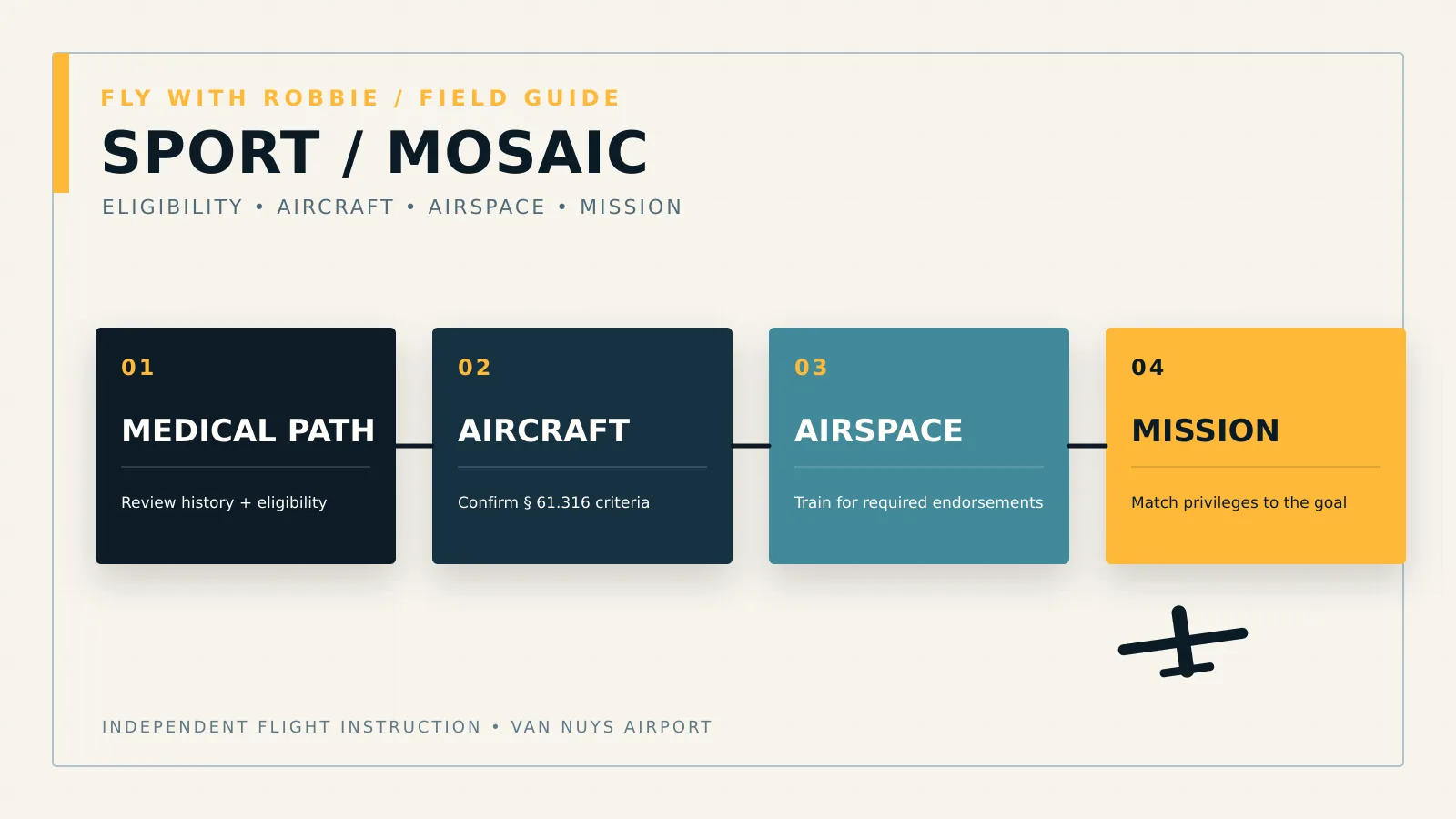
A current, source-linked guide to Sport Pilot training at Van Nuys after MOSAIC: driver-license medical eligibility, aircraft limits, Class D endorsements, training hours, night privileges, and progression options.
Short answer
Sport Pilot training is available at Van Nuys, but operating from VNY requires the appropriate Class D/towered-airport training and endorsement. Eligible pilots may use a current and valid U.S. driver’s license as medical qualification, subject to the restrictions in 14 CFR § 61.303 and the rule against flying with a known unsafe medical condition. MOSAIC expanded eligible airplane characteristics and added endorsement paths, but it did not erase certificate, medical-history, aircraft, airspace, or operational limits.
What is effective now
This guide was reviewed August 16, 2026 against the current FAA MOSAIC page and eCFR. It distinguishes the Sport Pilot operating rules already in effect from the separate aircraft-certification implementation date. Because the subject can change, the linked FAA sources—not an old blog summary—control.
| MOSAIC milestone | Effective date | Why it matters |
|---|---|---|
| Sport Pilot certification, privileges, and related endorsements | October 22, 2025 | Current pilot rules include the expanded § 61.316 aircraft criteria and new endorsement paths |
| New light-sport aircraft certification rules | July 24, 2026 | Part 22 and updated consensus-standard framework applies to new LSA certification |
Who Sport Pilot may fit
Sport Pilot is not automatically the “easier Private Pilot.” The better certificate depends on the aircraft, passenger count, weather, airspace, night plans, travel goals, and medical eligibility. A Private Pilot certificate remains the more flexible path for many students, while Sport Pilot can be the right fit for a narrower mission.
- A prospective pilot whose mission is primarily personal daytime flying with no more than one passenger
- An eligible person who wants to use a current and valid U.S. driver’s license as medical qualification
- A pilot who accepts the operating limits in exchange for a lower airplane-category minimum experience requirement
- An existing pilot who wants to exercise Sport Pilot privileges in an eligible aircraft
The driver-license medical pathway
| Question | Practical answer |
|---|---|
| Can a driver’s license substitute for an FAA medical? | For an eligible pilot exercising applicable Sport Pilot privileges, yes; the license must be current and valid and its restrictions still apply |
| What if I previously applied for an FAA medical? | Your most recent application must have resulted in eligibility for at least a third-class medical |
| What if my medical was suspended or revoked? | The driver-license pathway is not available when the most recently issued medical was suspended or revoked, or the most recent Special Issuance was withdrawn |
| What if I have a condition that affects safe flight? | You may not fly when you know or have reason to know of a condition that would make the operation unsafe |
Training requirements for airplane single-engine privileges
Under § 61.313, the airplane single-engine minimum is 20 hours: at least 15 hours of flight training and at least 5 hours of solo training. The required experience includes two hours of cross-country training, specified takeoffs and landings, a solo cross-country of at least 75 nautical miles total distance with the required landings and segment, and practical-test preparation within the applicable two-calendar-month period.
Twenty hours is an eligibility floor, not a completion guarantee. At Van Nuys, radio work, taxi planning, wake-turbulence awareness, and Class D operations are part of becoming independently safe. Training continues until the knowledge, risk management, and flight proficiency standards are met.
Can a Sport Pilot fly from Van Nuys?
Yes. Van Nuys is a towered Class D airport, so § 61.325 matters. A Sport Pilot seeking those privileges must receive and log the required ground and flight training in radio communications, navigation facilities, radar services, controlled-airspace operations, and the applicable airport and airspace procedures, then receive the instructor endorsement.
That requirement makes VNY a workable training base rather than an automatic exclusion. The training must be deliberate: listen, plan the call, understand runway and taxi instructions, know the airspace above and around the airport, and recognize when workload justifies asking for clarification.
What airplanes qualify after MOSAIC?
The aircraft a Sport Pilot may operate is defined by § 61.316, not simply by a marketing label. For airplanes, the current rule allows a maximum seating capacity of four while the Sport Pilot remains limited to one passenger. The airplane must meet the applicable stall-speed, cabin, power-loss, landing-gear, and propeller criteria since original certification. Retractable gear or a manual controllable-pitch propeller requires the additional § 61.331 training and endorsement.
Aircraft eligibility and rental availability are separate questions. A particular airplane may satisfy the regulatory performance and design limits but still be unavailable for solo rental, restricted by insurance, or unsuitable for a student’s stage of training. Confirm the exact make, model, configuration, operating limitations, and provider rules before building a budget around it.
Privileges and limitations that are often misunderstood
| Topic | Current practical summary |
|---|---|
| Passengers | No more than one passenger, even if an eligible airplane has four seats |
| Compensation | No acting as PIC for compensation or hire, carrying passengers/property for compensation, or flying in furtherance of a business |
| Controlled airspace | Class B, C, D, and towered-airport operations require the § 61.325 training and endorsement |
| Night | Requires § 61.329 night training and endorsement plus an FAA medical or compliance with the BasicMed conditions referenced by the rule |
| International | The certificate does not meet ICAO requirements; prior authorization from the country is required |
| Aircraft | Must meet § 61.316 and any applicable endorsement requirements |
Can Sport Pilot training lead to Private Pilot?
Yes, but plan the transition rather than assuming every hour will satisfy every Private Pilot requirement automatically. Training and logged experience may count when it meets the applicable rule and was provided by an instructor authorized for that training. The Private Pilot applicant must still complete all remaining aeronautical experience, knowledge, medical qualification, endorsements, and practical-test requirements.
If your likely mission includes more passengers, broader aircraft access, regular night flying, or operations beyond Sport Pilot limits, beginning directly with Private Pilot training may be more efficient. If the driver-license pathway and a focused recreational mission are central, Sport Pilot training at Van Nuys deserves a careful eligibility conversation.
Before committing to a Sport Pilot plan
- Review your complete FAA medical application and certificate history.
- Define the aircraft, passenger, night, airspace, weather, and travel mission you actually want.
- Confirm the exact aircraft meets § 61.316 and is realistically available for training and solo use.
- Budget for proficiency rather than only the 20-hour minimum.
- Plan the § 61.325 controlled-airspace training and endorsement for Van Nuys operations.
- Recheck current FAA sources if the plan depends on a recently implemented MOSAIC provision.
Frequently asked questions
Questions pilots ask about this topic
Can I learn to fly without an FAA medical?
Possibly. An eligible Sport Pilot may use a current and valid U.S. driver’s license as medical qualification, but prior medical denials, suspensions, revocations, withdrawn Special Issuance authorizations, license restrictions, and known unsafe medical conditions matter.
Can a Sport Pilot fly from Van Nuys Airport?
Yes, after completing and logging the required controlled-airspace and towered-airport training and receiving the § 61.325 endorsement.
Can a Sport Pilot fly a four-seat airplane?
An airplane may have up to four seats if it satisfies § 61.316, but the Sport Pilot may still carry no more than one passenger.
Can a Sport Pilot fly at night?
Yes only after meeting the § 61.329 night training and endorsement requirements and holding an FAA medical or meeting the referenced BasicMed conditions. A driver’s license alone does not qualify the pilot for night operations.
Primary references
Verify the controlling information
Regulations, procedures, avionics, weather, and airport information can change. Use the current official source for an actual flight or certification decision.
- FAA MOSAIC implementation and effective dates ↗
- FAA Sport Pilot overview after MOSAIC ↗
- 14 CFR Part 61, Subpart J — Sport Pilots ↗
- 14 CFR § 61.303 — Driver-license medical conditions ↗
- 14 CFR § 61.316 — Eligible aircraft criteria ↗
- 14 CFR § 61.325 — Controlled-airspace endorsement ↗
- 14 CFR § 61.329 — Night privileges ↗