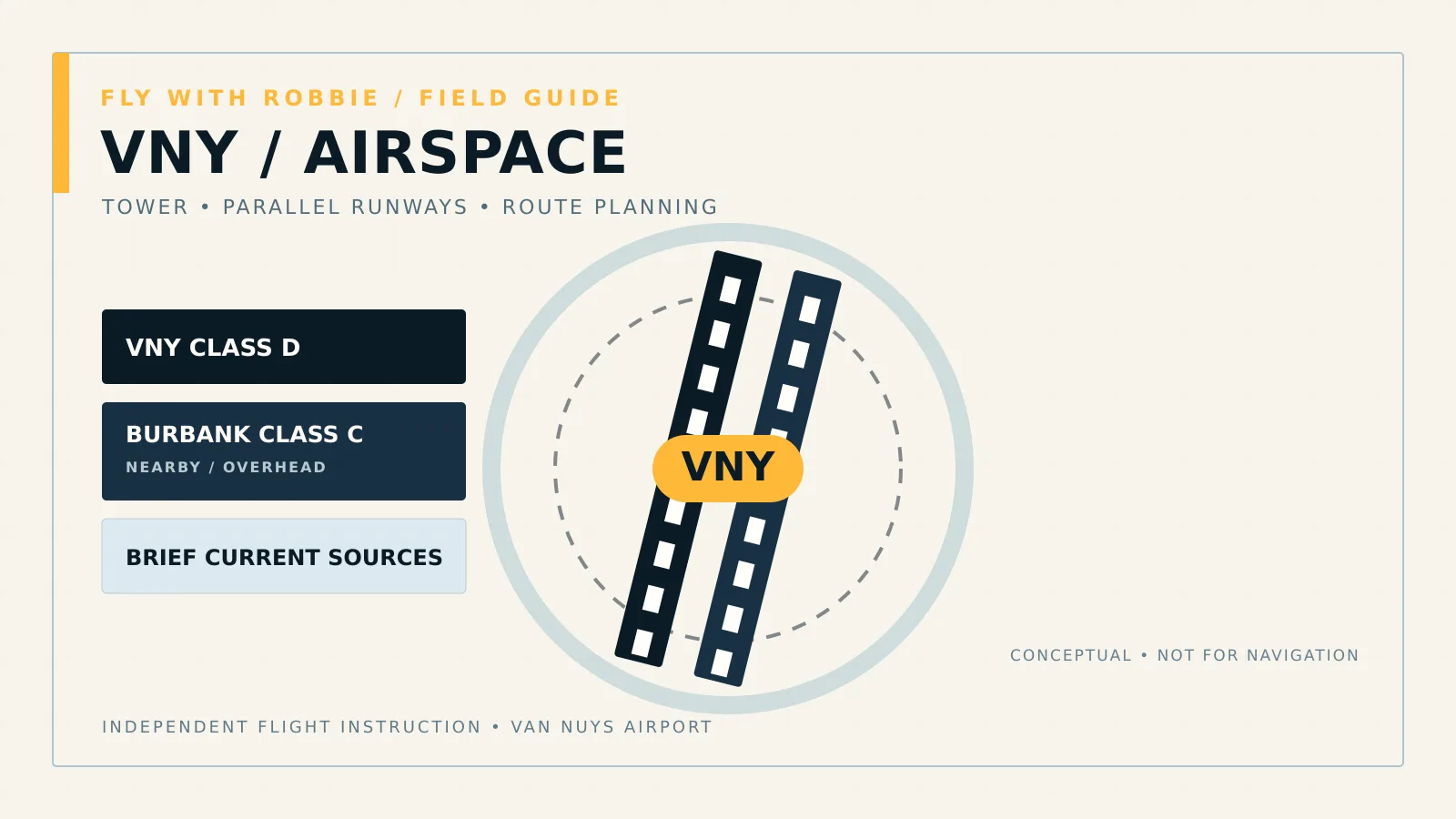
A student-focused planning guide to Van Nuys Class D, the overlying Burbank Class C, parallel runways, radio workload, local orientation, practice-area departures, and current-source discipline.
Short answer
Van Nuys Airport is Class D and lies beneath the Burbank Class C structure. The airport has closely spaced parallel runways and significant general-aviation and business-jet traffic. Student pilots can train safely and effectively there by briefing current charts and NOTAMs, knowing runway and taxiway geometry, preparing radio calls, respecting wake turbulence, and using nearby lower-workload areas for maneuver practice.
Start with the current chart, not a memorized boundary
The VNY Class D and overlying Burbank Class C are easy to describe and dangerous to reduce to one remembered altitude. Airspace, frequencies, procedures, and temporary restrictions can change. Use the current Los Angeles sectional, Chart Supplement, airport diagram, NOTAMs, and ATC information for every flight.
The lasting skill is reading the vertical and lateral picture before takeoff: where the Class D ends, where the Class C begins, which direction the route goes, what altitude remains available, and what communication or clearance is required next.
Airport geometry and workload
| Feature | Training implication |
|---|---|
| Closely spaced parallel runways | Confirm runway assignment and maintain runway-specific situational awareness |
| Staggered thresholds | Do not infer runway position from a quick glance; use the airport diagram |
| Business jets and training aircraft | Anticipate speed differences and wake turbulence |
| Multiple taxiways and ramp areas | Write or visualize taxi clearance; stop and ask when uncertain |
| Burbank Class C overhead/east | Brief altitude and route before departure; monitor position continuously |
Local landmarks support—but never replace—the chart
The Sepulveda Basin, major freeways, and mountain passes can help a student connect the sectional to the view outside. Their value is orientation, not legal boundary definition. Visibility, haze, sun angle, and unfamiliar perspective can make a prominent landmark surprisingly hard to identify.
Before using a landmark, point to it on the chart, identify what airspace lies beyond it, and define what you will do if you cannot see it. GPS position can confirm orientation, but the pilot should still understand the surrounding structure instead of following the airplane symbol.
A practical radio method
- Listen long enough to understand runway flow, frequency pace, and whether the controller is already calling you.
- Know the request before keying the microphone: who you are calling, who you are, where you are, and what you want.
- Read back runway assignments, hold-short instructions, altitudes, and other safety-critical items accurately.
- If a clearance is unclear, say so. A short clarification is better than a confident wrong turn.
- Use “student pilot” when useful; it gives ATC context, not permission to stop listening.
Training should alternate busy and quiet environments
Van Nuys builds communication, taxi, spacing, and workload skills. Nearby practice areas and less-busy airports provide time to repeat maneuvers, landings, and navigation decisions. A strong syllabus uses each environment for what it teaches best instead of claiming that maximum traffic is always maximum learning.
For instrument students, the same principle applies: work with SoCal Approach and fly varied approaches, but create enough lower-workload practice that scan and procedures become stable before adding rapid changes. See what IFR training in Los Angeles is actually like.
Van Nuys preflight briefing checklist
- Current airport diagram, Chart Supplement, sectional, NOTAMs, and runway-safety material reviewed
- Runway flow, taxi route, hotspot awareness, and likely crossing/hold-short points briefed
- Class D and overlying/adjacent airspace understood for the planned route and altitude
- Wake-turbulence plan for heavier traffic considered
- Departure frequency and initial request prepared
- Lost-orientaton and lost-communication actions discussed at the student’s level
- Noise-abatement and local procedures checked from current official sources
Frequently asked questions
Questions pilots ask about this topic
Is Van Nuys too busy for a student pilot?
No, when the instructor introduces workload progressively and uses nearby lower-workload areas for repetition. Students should not be expected to master aircraft control and dense radio work simultaneously on day one.
Is learning at a busy airport better?
It is better for certain skills—communication, taxi planning, traffic awareness, and workload management. Quieter environments may be better for early maneuver repetition. A balanced syllabus uses both.
Can Sport Pilots fly from Van Nuys?
Yes, after completing the controlled-airspace and towered-airport training and endorsement required by § 61.325, along with all other applicable requirements.
Primary references
Verify the controlling information
Regulations, procedures, avionics, weather, and airport information can change. Use the current official source for an actual flight or certification decision.