A practical comparison of G1000, traditional six-pack, and hybrid panels for primary, instrument, transition, and aircraft-owner training—without declaring one universally better.
Short answer
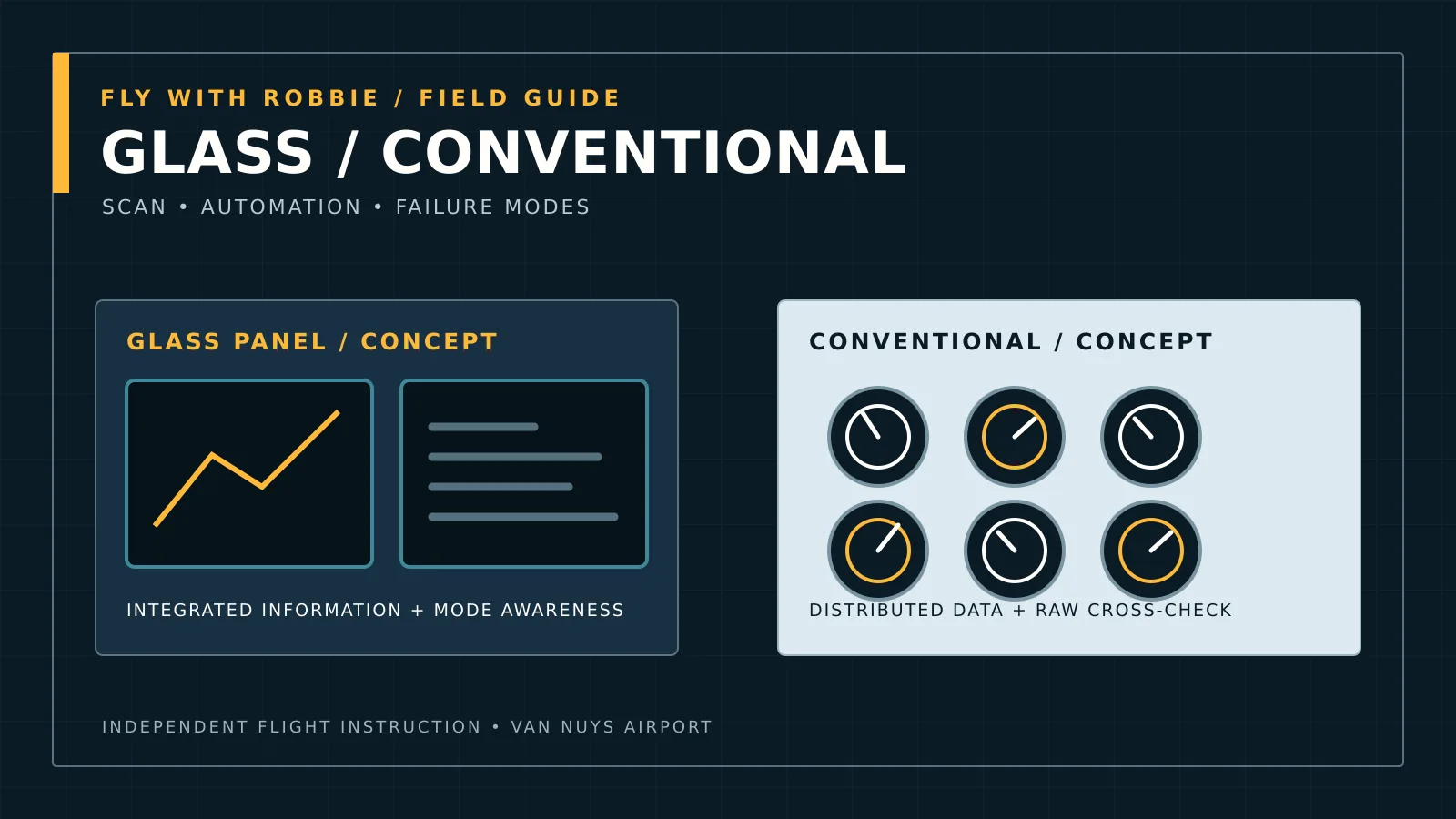
A G1000 is not automatically easier, and a six-pack is not automatically better for learning fundamentals. Glass consolidates attitude, navigation, traffic, terrain, and system information, while conventional instruments make failure identification and raw-data cross-checks more obvious. The best training panel is the one that matches the aircraft you expect to fly, supported by instruction that teaches mode awareness, cross-checking, and failures rather than button sequences alone.
The useful comparison is workload, not screen versus gauges
| Training question | G1000 / integrated glass | Conventional six-pack | Hybrid or upgraded panel |
|---|---|---|---|
| Instrument scan | Smaller physical scan with integrated tapes and attitude | Wider scan across separate instruments | Varies; requires deliberate source awareness |
| Navigation | Flight-plan, CDI, bearing, and approach functions are tightly integrated | Often a separate GPS/NAV/COM plus mechanical indicators | May mix digital GPS with legacy indicators |
| Automation | Mode annunciations and autopilot integration can reduce or multiply workload | Usually less integrated; manual control remains prominent | Capability may be high but interfaces are less uniform |
| Failure training | Display, AHRS, ADC, magnetometer, GPS, and electrical failures | Vacuum, pitot-static, gyro, electrical, and individual-instrument failures | Requires an equipment-specific failure map |
| Transfer value | Strong for modern TAA and integrated avionics | Strong raw-data foundation and broad legacy-fleet familiarity | Excellent when it matches an owner’s actual airplane |
What G1000 training should actually include
The central habit is predict—select—verify. Before pressing a key or changing a mode, say what the system should do. After the change, verify the annunciation and the aircraft response. If the result is unexpected, reduce automation before troubleshooting. This is more transferable than memorizing a sequence from one software version.
- A consistent power-up, database, annunciation, and sensor-status check
- Positive identification of navigation source and active/standby frequencies
- Flight-plan editing without losing awareness of the airplane’s path
- Approach loading versus activation, sequencing, vectors-to-final, and missed-approach behavior
- Autopilot mode selection, capture logic, disconnects, trim, and reversion to hand flying
- Reversionary display operation and realistic AHRS, ADC, GPS, display, and electrical failures
What conventional instruments teach well
A conventional panel makes the instrument cross-check physically visible. Because information is distributed, the pilot must interpret relationships among attitude, performance, and navigation instruments. That can build strong raw-data habits and makes certain individual-instrument failures easier to isolate.
The disadvantage is not that the panel is old; it is that a pilot can learn a rote scan without understanding the system behind each instrument. Vacuum-driven gyros, electrical instruments, pitot-static instruments, and the installed GPS still require an equipment-specific failure plan.
Should every student learn six-pack before glass?
No universal rule requires that sequence. A student who expects to fly a G1000 Cessna 172 should become deeply competent in that airplane rather than delaying relevant training to satisfy a slogan. A pilot who will rent from a mixed fleet benefits from intentional exposure to both.
The better test is whether the student can maintain control and navigate when a normal information source or automation feature is removed. That can be trained on either panel. Good instruction prevents glass from becoming a moving-map dependency and prevents conventional-panel training from becoming resistance to useful automation.
Instrument-rating and checkride considerations
Train in the airplane and avionics you plan to use for the practical test early enough that button-pushing no longer consumes the entire workload budget. The Instrument Rating ACS evaluates use of installed equipment and automation as appropriate, but the applicant must also recognize and manage failures and maintain safe aircraft control.
For Los Angeles IFR, avionics fluency matters because a late clearance change can arrive while the pilot is configuring, briefing, and communicating. The goal is not maximum use of automation. It is the correct level of automation for the phase of flight and the pilot’s current capacity.
Aircraft-owner training should begin with the exact installation
Fly With Robbie can provide training in a suitable owner-provided aircraft or coordinate G1000 and conventional-panel aircraft at Van Nuys. The training plan should follow the installed equipment and the missions you actually intend to fly.
- Identify the exact display, navigator, autopilot, software, databases, and supplements installed.
- Read the current aircraft flight manual or POH supplements and the correct Garmin Pilot’s Guide—not a guide for a different airframe.
- Map normal and emergency electrical power, sensors, circuit protection, and reversion paths.
- Practice common tasks on the ground before paying for aircraft time.
- Fly realistic failures and automation surprises at a safe workload and altitude.
- Build personal minimums for hand flying, single-pilot IFR, and equipment degradation.
Decision guide
| Your likely flying | Sensible emphasis |
|---|---|
| You own or plan to buy a glass-panel airplane | Train primarily in that installation; add raw-data and failure work deliberately |
| You will rent from a mixed fleet | Develop a primary panel first, then complete structured transition training in the other |
| You are earning an instrument rating in a G1000 airplane | Use the G1000 throughout the rating and make mode/failure management part of every stage |
| You are current on six-pack but moving to glass | Do not treat the transition as cosmetic; train flight planning, approaches, autopilot, and failures |
| You are current on glass but renting legacy aircraft | Rebuild the wider scan, equipment interpretation, and partial-panel procedures before operating IFR |
Frequently asked questions
Questions pilots ask about this topic
Is G1000 harder to learn?
The display is usually intuitive, but the number of functions and automation modes can create high workload until the pilot develops a consistent workflow. Ground preparation greatly reduces expensive in-airplane learning.
Does G1000 make instrument flying safer?
It can improve information access and situational awareness, but only when the pilot understands the system, verifies modes and data, and can respond to failures. Mismanaged automation can increase workload.
Can I take an instrument checkride in a G1000 airplane?
Yes, when the airplane and equipment meet the applicable requirements. Training should include normal use, automation management, and realistic failure procedures for the installed system.
Can I get instruction in my own aircraft?
Yes, if the airplane is suitable and operating, insurance, maintenance, and instructor requirements are met. Owner-aircraft instruction is most effective when it uses the exact manuals and supplements for that installation.
Primary references
Verify the controlling information
Regulations, procedures, avionics, weather, and airport information can change. Use the current official source for an actual flight or certification decision.