A practical decision guide for instrument-rated pilots: the six-calendar-month currency rule, the second six-month window, IPC requirements, proficiency scenarios, and a return-to-IFR plan.
Short answer
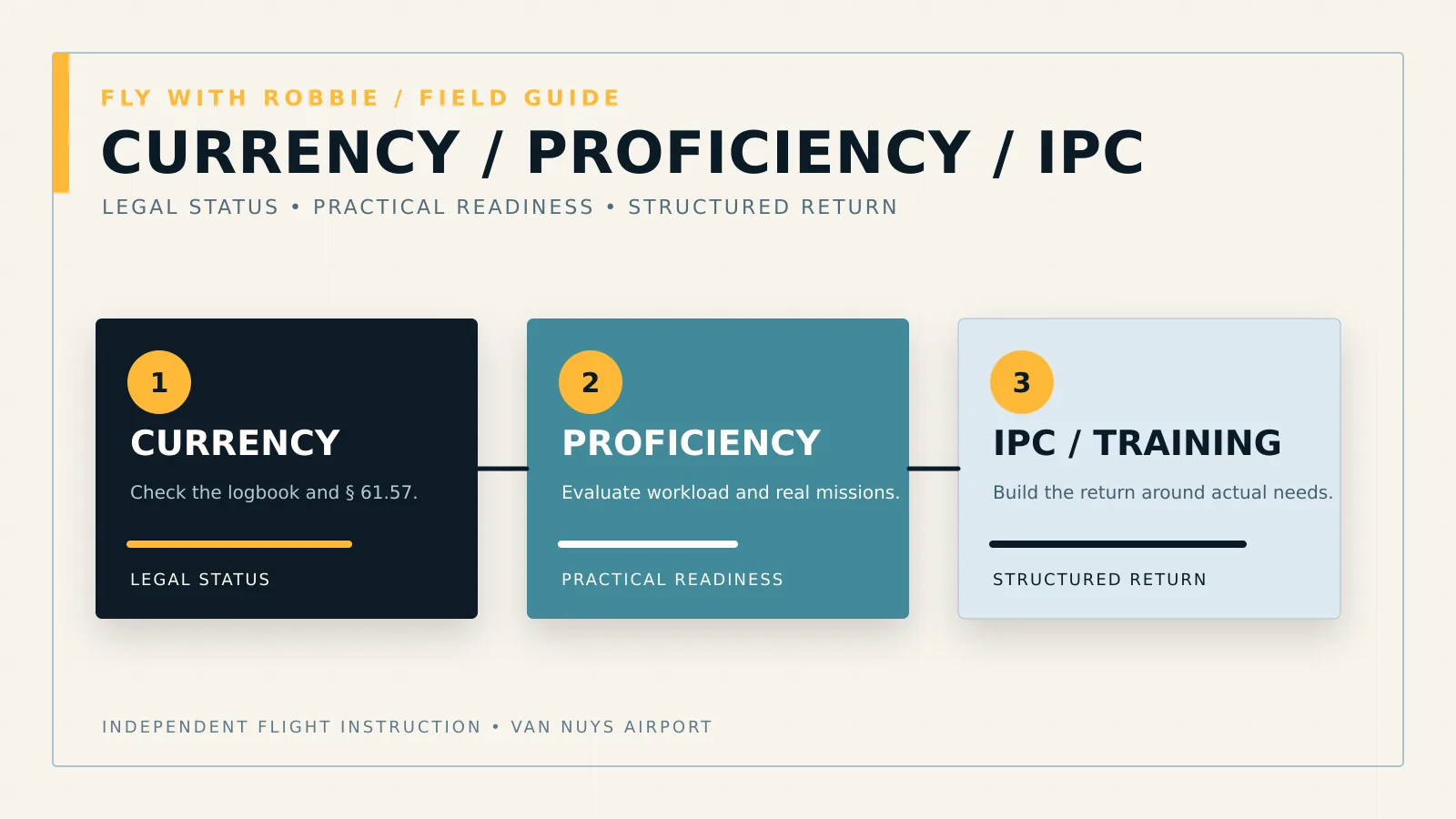
IFR currency is a regulatory threshold; IFR proficiency is the ability to manage the flight safely today. Under 14 CFR § 61.57(c), an instrument-rated pilot generally maintains recent experience by completing six instrument approaches plus holding procedures and intercepting/tracking tasks within the preceding six calendar months. If those tasks have not been completed for more than six calendar months after currency lapsed, § 61.57(d) requires an Instrument Proficiency Check to reestablish currency. A legally current pilot may still need instruction before flying challenging IFR.
Three different questions
| Question | What it means | Who decides |
|---|---|---|
| Am I legally current? | You meet the applicable recent-experience requirements of § 61.57 | The regulation and your accurate records |
| Am I proficient for this flight? | Your present skills match the weather, aircraft, avionics, airspace, and single-pilot workload | The pilot in command, using honest risk assessment |
| Do I need an IPC? | Your currency cannot be reestablished through recent-experience tasks alone, or you choose a formal proficiency evaluation | § 61.57(d), applied to your timeline; completion endorsed by an authorized evaluator |
The instrument-currency timeline
| Status | May you act as PIC under IFR? | Typical next step |
|---|---|---|
| Required recent experience completed within the preceding six calendar months | Yes, if all other requirements and conditions are met | Evaluate actual proficiency for the proposed flight |
| Currency lapsed, but the additional six-calendar-month period has not expired | No | Regain the required experience using an allowed method and appropriate safety pilot/instructor/device conditions |
| Requirements not met for more than six calendar months after currency lapsed | No | Complete an IPC under § 61.57(d) |
Legally current can still be operationally rusty
Consider a pilot who completed six approaches in benign simulated conditions, then plans a night departure through a low coastal layer in an unfamiliar glass-panel airplane. The logbook may satisfy § 61.57, but the proposed flight adds weather, darkness, equipment transition, and high workload that those approaches did not test.
Proficiency should be specific. Ask whether you can copy and brief a clearance, hand-fly precisely, use and monitor the installed autopilot, reprogram an approach after a change, recognize a bad mode, fly a missed approach, manage a failure, and decide early enough to divert. If several answers are uncertain, targeted instruction is sensible even when an IPC is not legally required.
What an IPC is designed to accomplish
An IPC is an evaluation and training event based on the applicable Instrument Rating ACS tasks and FAA guidance. It is not defined by a universal number of hours. The evaluator must determine that the pilot meets the required standard before providing the endorsement. If the standard is not yet met, the work is logged as training and continues without labeling the pilot as having “failed a checkride.”
A useful IPC begins before engine start. Recent experience, intended missions, aircraft systems, avionics, weather decision-making, alternate planning, and risk management guide the scenario. The flight or approved-device portion then evaluates the required instrument tasks and any additional areas needed for safe return to the pilot’s actual operation.
Do I need an IPC? A practical decision checklist
- Confirm the exact date and content of your last logged instrument experience and any prior IPC.
- If the § 61.57(c) tasks are current, an IPC is not automatically required—but assess proficiency for the intended flight.
- If currency lapsed, determine whether you remain inside the additional six-calendar-month recovery window.
- If you are outside that recovery window, plan an IPC before acting as PIC under IFR or in weather below VFR minimums.
- Regardless of legality, choose instruction when returning after a long absence, changing aircraft or avionics, or preparing for conditions substantially harder than recent practice.
- Bring accurate records to the CFII rather than relying on a memory of “a few approaches last summer.”
Five common return-to-IFR scenarios
| Pilot | Legal question | Practical training plan |
|---|---|---|
| Current, but only in VMC under the hood | Likely current if all tasks and conditions were met | Weather, approach, missed-approach, and decision scenarios matched to intended IFR |
| Out of instrument flying for one year | Exact calendar-month calculation determines whether IPC is required | Ground review, avionics refresh, baseline flight/device session, then IPC if required |
| Buying a new glass-panel airplane | Currency may carry over, but equipment qualification and proficiency are separate | Aircraft-specific transition, automation failures, approaches, and missed approaches |
| Returning after several years | IPC required | Do not schedule a one-flight box check; plan staged ground and flight work |
| Frequent VFR pilot who rarely flies IFR | May or may not be current | Instrument scan, clearances, weather, approach setup, failures, and real mission workload |
IPC, flight review, and simulator use
An IPC and a flight review answer different requirements. A flight review under § 61.56 includes at least one hour of flight training and one hour of ground training and covers the specified operating rules and maneuvers. An IPC addresses instrument recency and proficiency. They can be planned in the same period when appropriate, but each requirement must be fully satisfied and separately documented; one does not automatically substitute for the other.
Full flight simulators, flight training devices, and aviation training devices may be used for instrument experience or portions of training only under the conditions allowed by the regulations and the device’s authorization. Devices are excellent for repetitions, failures, and weather scenarios, but the logbook entry and operating conditions still matter.
How to make an IPC more useful
Los Angeles-area pilots can arrange an Instrument Proficiency Check at Van Nuys or targeted instrument refresher training without waiting until a regulatory deadline forces the issue.
- Send currency records, aircraft type, avionics, and normal missions before the session.
- Identify the conditions you have been avoiding—not only the approaches you can already fly.
- Review the current ACS and aircraft supplements before arriving.
- Ask for a scenario that includes a change, missed approach, abnormal event, and decision point.
- Leave with a next-90-days proficiency plan rather than treating the endorsement as the finish line.
Frequently asked questions
Questions pilots ask about this topic
Can I legally fly IFR if I am current but rusty?
Currency may satisfy the recent-experience rule, but the pilot in command must still determine that the flight is safe. Conditions, aircraft, avionics, fatigue, and the depth of recent practice can make additional training the prudent choice.
How long does an IPC take?
There is no universal duration. It depends on recent experience, preparation, aircraft and avionics familiarity, and demonstrated performance against the applicable standard.
Can an IPC be completed in a simulator?
An approved simulator or training device may be used when the regulatory and device-authorization conditions are satisfied. The exact device and tasks should be confirmed before scheduling.
Does an IPC count as a flight review?
Not automatically. The two events have different requirements. They may be coordinated, but every element of each must be completed and documented.
Primary references
Verify the controlling information
Regulations, procedures, avionics, weather, and airport information can change. Use the current official source for an actual flight or certification decision.